Indexes can be implemented using balanced trees, B+ trees, and hashes
Type of index:
Primary Index Fussy Index reversed index GSI LSI
@startuml
class IntColumnDataType{
	min_value
	max_value
	void validate(value)
}
class StringColumnDataType{
	min_value
	max_value
	void validate(value)
}

ColumnDataType <|-- IntColumnDataType

ColumnDataType <|-- StringColumnDataType

class ColumnDataType{
	String type
	void validate(value)
}

class ColumnSchema{
	ColumnDataType type
	String name
	required
	void allowNull()
	void validateValue()
}

ColumnDataType -->ColumnSchema

class TableSchema{
	schema_members
	allow_undefined
	validate_row_data()
}

ColumnSchema -->TableSchema

class Index{
	index_name
	primary_key
}

class Table{
	table_name
	table_schema
	indexes
	primary_key
	table_data
}
Table *-- TableSchema
Database *-- Table
Table *-- Index
class Database{
	db_name
	tables
	create_tables()
	delete_tables()
}


@enduml
TableSchema
validate_row_data(){
validates row data
Multi level validation
TableSchema : validates any undefined values
SchemaMember : validates null check
Column_data_type: validates value type and ranges.
}
-
ColumnDataType class: This includes different data types we can use for our columns. Here we can also have custom validations on each of the datatypes.
-
SchemaMember class: This is the actual column that our table schema would use. Here we can define the column name, type, and different validations on the column like null allowed, required or not, etc.
-
TableSchema class: This is the schema that will be used by the table to validate and store each row. Here we can define all schema members and validation methods as well.
SchemaMember def validate_value(self, val){
//validates column value
if val is None and not allow_none:
raise InvalidValueException(f"None_not_allowed_in_{self.column_name}")
return self.column_type.validate(val)
}
Index:
- Index class: This is the base for implementing different types of indexes defined by index_name and index_storage. Provides methods to index/query data and also to remove indexed value as well.
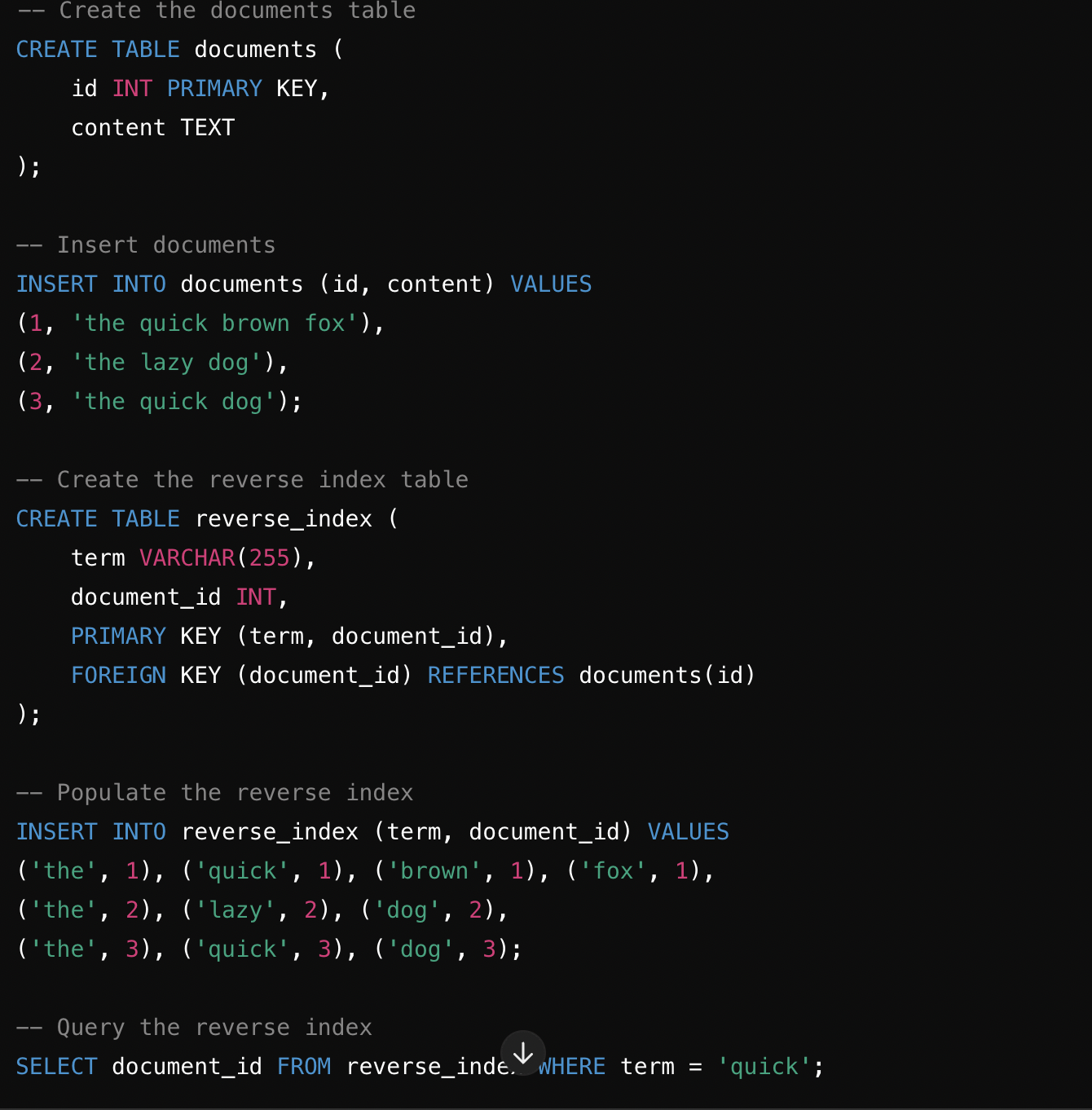
Reverse Index:
# create schema
user_schema = TableSchema()
user_schema.add_schema_member(SchemaMember("user_id", StrDataType(0, 10), required=True))
user_schema.add_schema_member(SchemaMember("user_name", StrDataType(0, 50)))
user_schema.add_schema_member(SchemaMember("user_age", IntDataType(0, 100), required=False))

# Create Table
user_table = Table(table_name="users", table_schema=user_schema, primary_key="user_id")

# create index
user_table.create_index("user_name", "FUZZY")

# insert seed data
user_table.insert_data({"user_id": "user1", "user_name": "new user", "user_age": 20})
user_table.insert_data({"user_id": "user2", "user_name": "improved user"})
user_table.insert_data({"user_id": "user3", "user_name": "diff guy", "user_age": 30})

print(user_table.filter_data({"user_name": "user"}))
# out : [{'user_id': 'user1', 'user_name': 'new user', 'user_age': 20},
# {'user_id': 'user2', 'user_name': 'improved user'}]

print(user_table.filter_data({"user_name": "user", "user_age": 20}))
# out : [{'user_id': 'user1', 'user_name': 'new user', 'user_age': 20}]

user_table.delete_data("user2")
print(user_table.filter_data({"user_name": "user"}))
# out : [{'user_id': 'user1', 'user_name': 'new user', 'user_age': 20}]