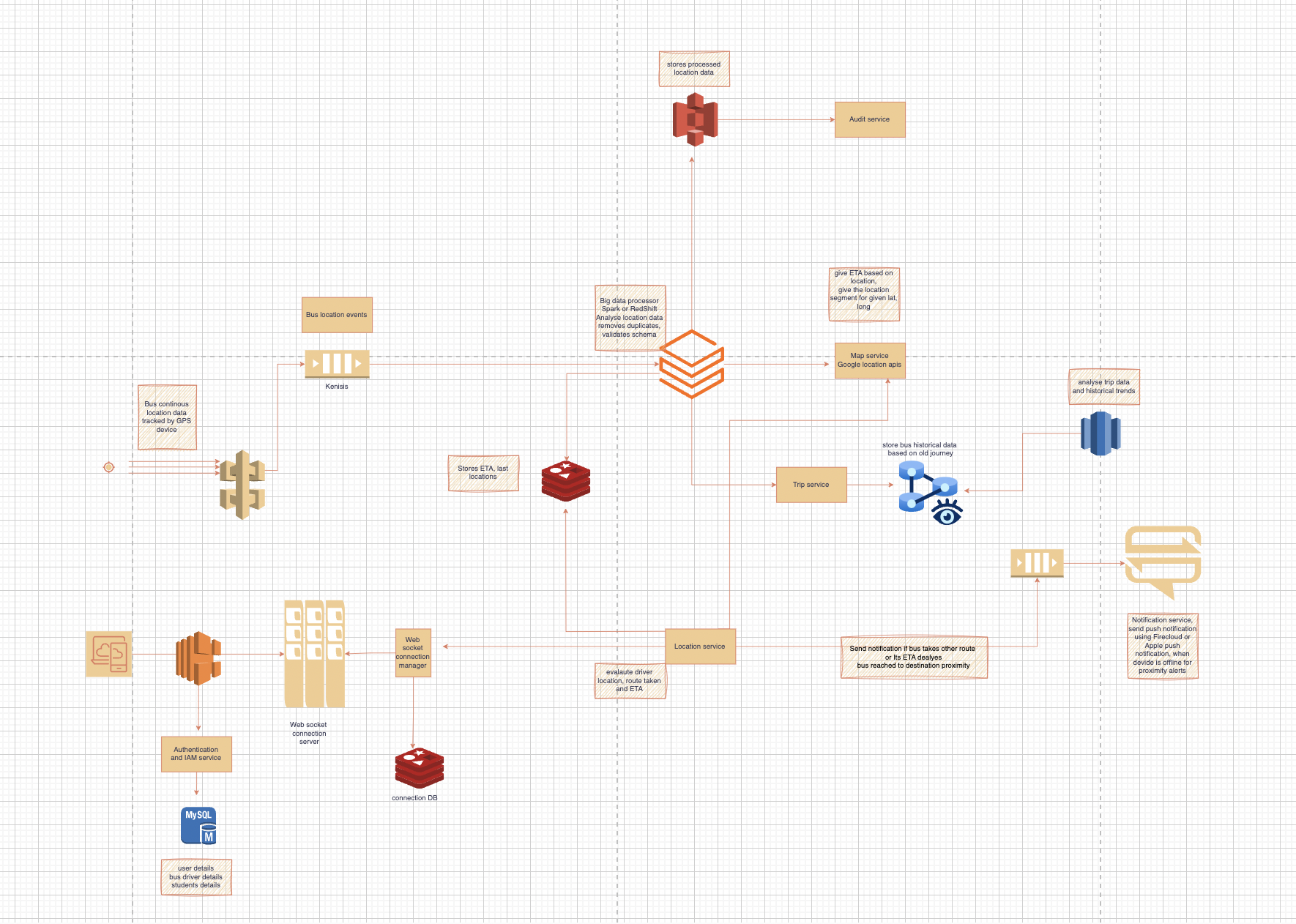
Functional requirement:
- The system should allow parents and school administrators to track buses in real-time.
- Notifications should be sent when the bus is near a specific location or running late.
NFR
System should be scalable, to handles ,multiple buses and multiples schools across country Data should be secured, as its a minor related application data Only the subscribed/logged in parents should be able to track only bus which carries their kids
What are the main components of your system?
The main components would be:
- Bus Device: A GPS device or mobile app installed on the bus to send location updates.
- Backend Service: A central service to ingest and process location data.
- Real-Time Tracking: A service to broadcast location updates to parents and school administrators.
- Notification Service: Sends alerts for events like proximity to a stop or delays.
- Database: Stores historical data, user profiles, and route information.
- Frontend: A web/mobile application for parents and admins to view the bus’s location.
How would you handle real-time location updates efficiently?
For real-time updates:
- Data Ingestion: Use a message queue like Kafka or RabbitMQ to handle GPS updates from multiple buses.
- Data Processing: A stream processing system like Apache Flink or Spark Streaming would process the updates and compute proximity to stops or delays.
- Broadcast Updates: Use WebSockets or a real-time messaging protocol like MQTT to push updates to subscribed clients (parents and admins). Use Google Maps API/Mapbox for MAP rendering
- Optimization: To reduce load, batch location updates or send them at regular intervals (e.g., every 10 seconds).
How would you design the notification system?
Notifications can be event-driven:
- Proximity Alerts: When the bus is within a defined radius of a stop, trigger a notification.
- Delay Notifications: Calculate ETA using historical traffic patterns and live data; notify users of delays.
- Implementation:
- Use an event-based architecture with Kafka to publish proximity/delay events.
- A Notification Service processes these events and sends messages via SMS, push notifications, or email using providers like Twilio or Firebase Cloud Messaging.
How would you ensure scalability as the number of schools and buses grows?
To ensure scalability:
- Microservices Architecture: Separate services for location tracking, notifications, and user management to scale independently.
- Load Balancing: Use a load balancer like AWS ALB or Nginx for backend services.
- Database Sharding: Partition the database by school ID or region to distribute the load.
- Caching: Use a distributed cache like Redis to store frequently accessed data like current bus locations.
- Horizontal Scaling: Deploy services on a Kubernetes cluster for dynamic scaling based on load.
How would you ensure data security and privacy?
Security is critical since this system involves minors. Key measures:
- Authentication and Authorization: Use OAuth2 for secure access. Ensure that only authorized users can access bus location data.
- Data Encryption: Encrypt sensitive data in transit (using HTTPS) and at rest (using database encryption).
- Access Control: Implement role-based access control (e.g., parents can only view their child’s bus).
- Audit Logging: Maintain logs for all user actions to detect unauthorized access.
How would you handle situations where GPS updates are delayed or lost?
- Fallback Mechanism: Use the last known location and calculate an estimated trajectory.
- Data Validation: Discard stale or duplicate GPS updates based on timestamps.
- Redundancy: Use backup GPS devices or mobile networks to minimize disruptions.
Hybrid Approaches
- Combine multiple methods based on the use case:
- Use push notifications for critical updates when the app is offline and WebSockets when the app is active. using Firebase Cloud Messaging (FCM) or Apple Push Notification Service (APNS) platforms
- Use long polling as a fallback mechanism if WebSockets fail.