Its a pattern to maintain consistency in distributed system via sequence of local messages. A Saga is a sequence of local transactions. Each local transaction updates the local database using the familiar ACID transaction frameworks and publishes an event to trigger the next local transaction in the Saga. If a local transaction fails, then the Saga executes a series of compensating transactions that undo the changes, which were completed by the preceding local transactions
Example Transaction systems while booking flight
Steps:
- deduct money
- reserve seat
- send confirmation
If anyone of the step fails we want all steps should be reverted. `succeed together or fail together
Sagas can be implemented in “two ways” primarily based on the logic that coordinates the steps of the Saga.
- Choreography based sagas
a local transaction publishes events that trigger other participants to execute local transactions. In an orchestrated-based saga, a centralized saga orchestrator sends command messages to saga participants telling them to execute local transactions.
there is no central coordinator to tell saga participants what to do. Saga participants subscribe to each other’s events and respond accordingly
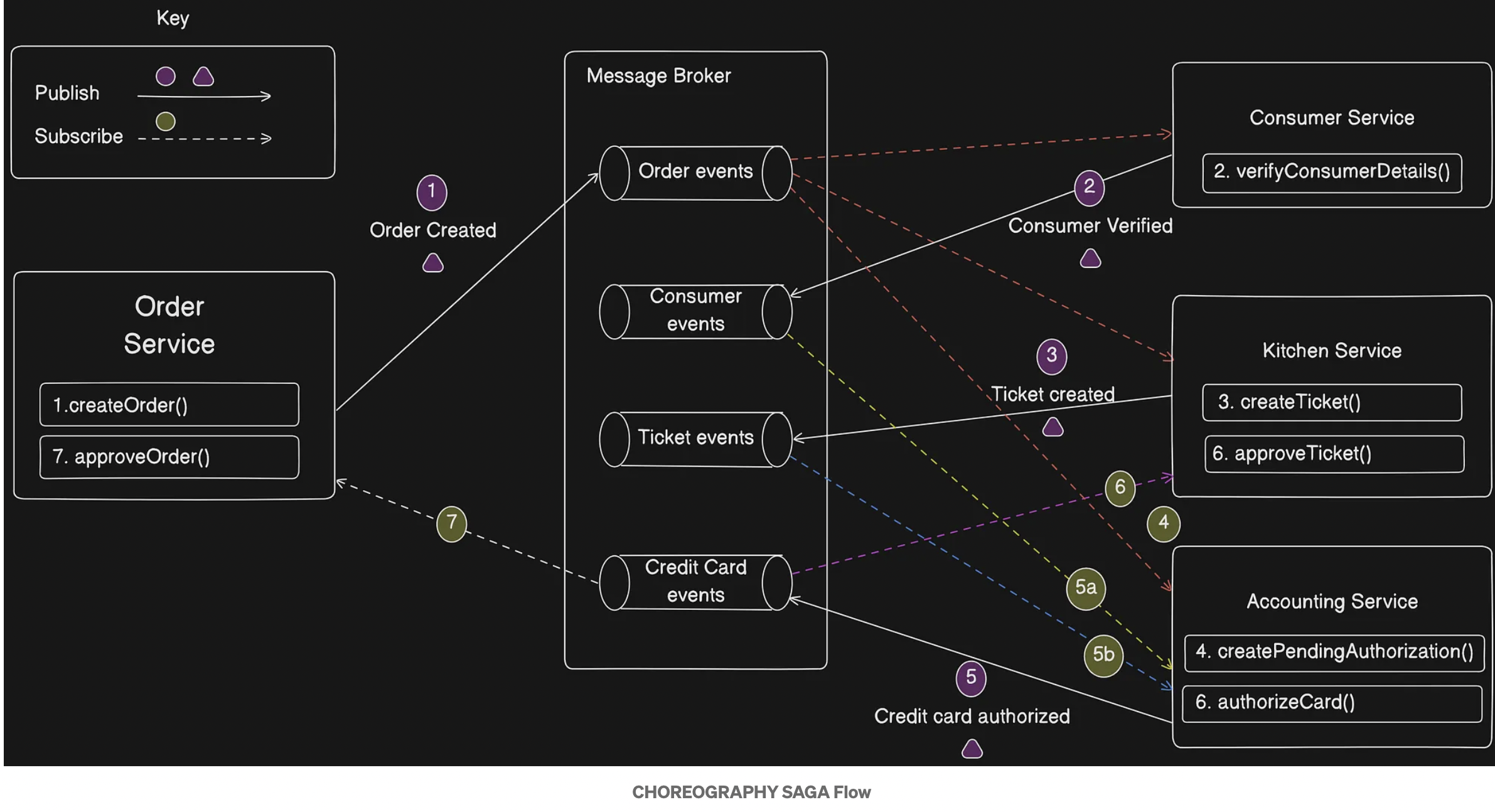 // this example flow is different than below example
The HAPPY path through this SAGA is as follows:
- Order Created: Customer places an order, Order Service records it as
PENDINGand publishes anOrderCreatedEvent. - Payment Processed/Failed: The Payment Service listens for
OrderCreatedEvent, processes payment. If successful, it publishesPaymentProcessedEvent; if failed,PaymentFailedEvent. - Inventory Reserved/Released: The Inventory Service listens for
PaymentProcessedEvent(or sometimesOrderCreatedEvent). If it reserves stock, it publishesInventoryReservedEvent. IfPaymentFailedEventoccurs, it compensates by releasing stock. - Order Status Updated: The Order Service listens for
PaymentProcessedEventorInventoryReservedEventto mark the orderCOMPLETED, or forPaymentFailedEventto mark itCANCELLED. - Shipping Initiated: The Shipping Service listens for
InventoryReservedEventto start the delivery process. FAILURE Scenario (Choreography - Payment Fails):
- Order Service: Creates
PENDINGorder, publishesOrderCreatedEvent. - Payment Service: Receives
OrderCreatedEvent, payment fails, publishesPaymentFailedEvent. - Order Service: Receives
PaymentFailedEvent, updates order toCANCELLED. - Inventory Service: (If it reserved stock earlier) Receives
PaymentFailedEvent(orOrderCancelledEvent), releases previously reserved stock (compensating transaction).
`Advantage: Loose coupling Simple
`Disadvantages: Difficulty in understanding the flow can lead to cyclic dependency
- Orchestration based sagas
a central Saga Orchestrator Service class is to tell saga participants what to do. Like Zookeeper
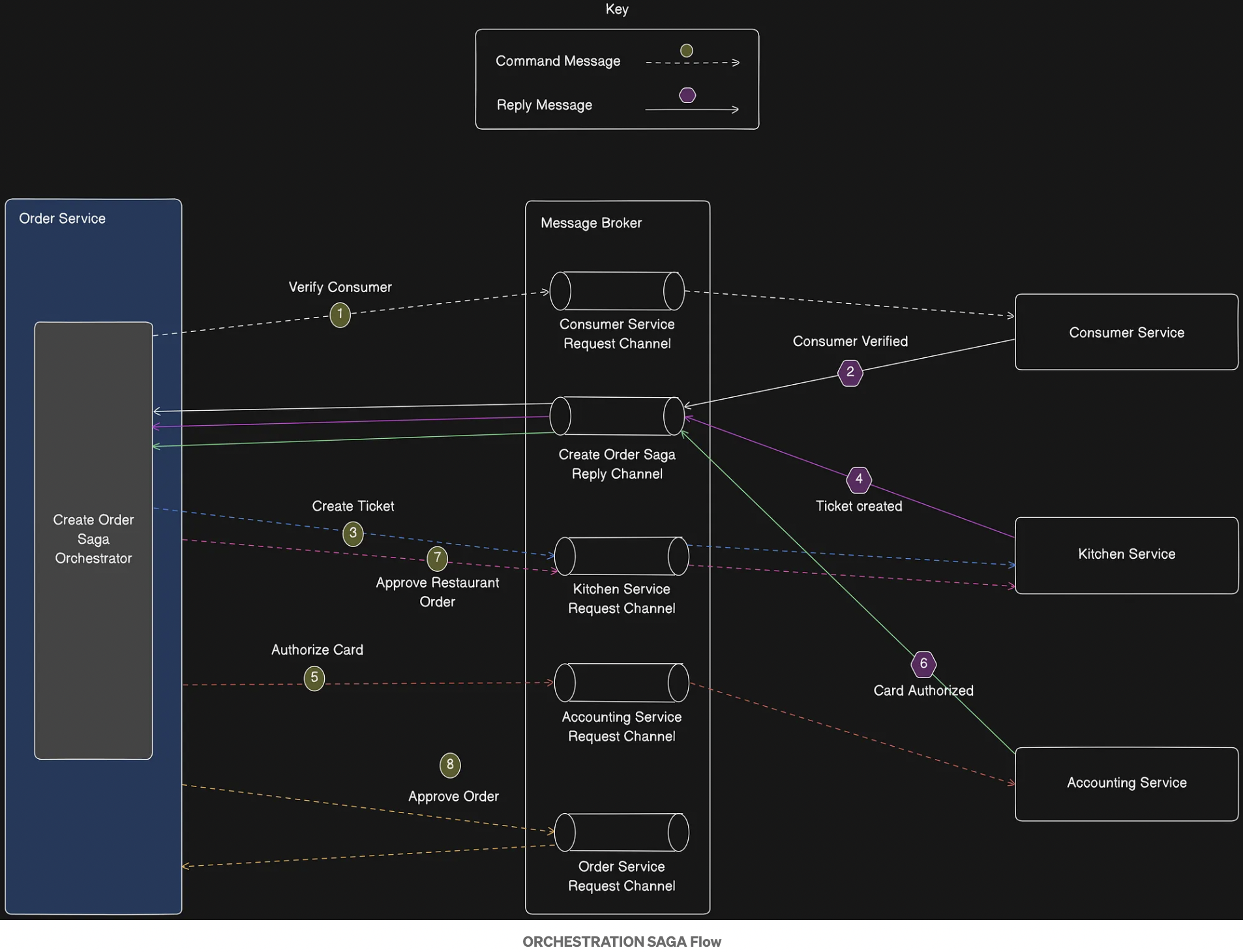
Scenario: User books a flight ticket. Services Involved:
-
Booking Orchestrator Service: The central brain.
-
Payment Service: Handles charging the user.
-
Flight Reservation Service: Reserves a seat on the flight.
-
Notification Service: Sends confirmation emails/SMS.
-
User initiates booking.
-
Booking Orchestrator Service (BOS):
- Tells Payment Service to charge user.
- Payment Service succeeds, replies to BOS.
- BOS then tells Flight Reservation Service to reserve seat.
- Flight Reservation Service succeeds, replies to BOS.
- BOS then tells Notification Service to send confirmation.
- Notification Service succeeds, replies to BOS.
- BOS marks booking
COMPLETED.
-
User initiates booking.
-
Booking Orchestrator Service (BOS):
- Tells Payment Service to charge user.
- Payment Service fails, replies to BOS.
- BOS receives failure, triggers compensating transactions:
- (If any prior steps succeeded, like a preliminary reservation, BOS would tell that service to undo it).
- BOS marks booking
FAILED.
Advantage Simpler dependencies Less coupling
Anomalies
There are three types of anomalies found in a typical saga.
-
Lost Updates — One saga overwrites an update made by another saga.
-
Dirty Reads — One saga reads data that is in the middle of being updated by another saga.
-
Fuzzy / Non-repeatable Reads — Two different sets of a saga read the same data and get different results because another saga has made updates.
-
Semantic Lock — This is an application-level lock, in which saga’s compensable transactions set a flag (e.g. Creating an Order can have flag status such as APPROVAL_PENDING, REVISION_PENDING, etc.) in any record that it creates or updates. This flag indicates that the record is not committed and that it has the potential to change. This could be cleared by a retriable transaction or a compensating transaction.
-
Commutative Updates — Designing the system to have more its update operations to be commutative (updates in an orderly manner). This can basically eliminate lost updates.
-
Pessimistic View — Reordering saga participants/services to minimize the effect of dirty reads.
-
Reread Values — This countermeasure reread values before updating it to further to re-verify the values are unchanged during the process. This will minimize lost updates.
-
By Value — This strategy will select concurrency mechanisms based on the business risk. This can help to execute low-risk requests using sagas and execute high-risk requests using distributed transactions.
It can be achieved using 2 phase commit . It can be achieved by keeping `cordination service like zookeeper. Two phase commit 2phase_commit