Requirements:
User should be able to login securely. User should be able to search upcoming flights from given date range and destination User should be able to watch booked history User should be able to book flight, and make a payment on the basis of first come first server. Flight can be connected 0 to 4 hop. User can book round trip or multi city flight as well Show users recent searches. Show flights in sort order based on: price, connecting, time duration, departure time, arrival time. Show only non connecting flight.
Not in scope Build Notification system for alerts Build analytical system Subscription system
NFR:
Book flight only if payment is successful. Fast flight searches. search api response within 500 ms. User from globe can book flight. Highly available search system.(if admin added flight if users see that after some latency its ok) Highly consistent booking system. Booking system needs to handle concurrent booking
Capacity estimates:
Daily active search: 1M Each flight has around seat count: 150 seat max Flight counts daily: 1k Daily booking: 150K = 1K * 150 ~ 150K / 86400
API:
`GET: /v1/flight Request body:
{
	"date": "232",
	"source" : "delhi",
	"destination" : "bangalore",
	"connecting" : true
}
Response:
{
	"status" : "success",
	"body" : [
		{
			"id": "hbksajdnkas",
			"startTime" : "9:00AM",
			"reachTime" : "11:00 AM",
			"price" : "2342342"
			"airline" " airindia",
			"flightDetails":[
				{
					"source" : "delhi",
					"destination" : "bangalore",
					"startTime" : "9:00AM",
					"reachTime" : "11:00 AM"
				}
			]
		},
		{
			"id": "as34fdf",
			"startTime" : "9:00AM",
			"reachTime" : "3:00 PM",
			"price" : "2342342"
			"flightDetails":[
				{
					"source" : "delhi",
					"destination" : "hydrabad",
					"startTime" : "9:00AM",
					"reachTime" : "10:00 AM"
				},
				{
					"source" : "hydrabad",
					"destination" : "bangalore",
					"startTime" : "01:00PM",
					"reachTime" : "3:00 3M"
				}
			]
		}
	]
}
`POST: /v1/flight Header: user auth token Request body:
{
	"id":"hbksajdnkas",
	"customerId":"hjkadsjka"
}
Response:
{
	"status" : "success",
	"body" : {
			"id": "hbksajdnkas",
			"startTime" : "9:00AM",
			"reachTime" : "11:00 AM",
			"price" : "2342342",
			"airline" " airindia",
			"flightDetails":[
				{
					"source" : "delhi",
					"destination" : "bangalore",
					"startTime" : "9:00AM",
					"reachTime" : "11:00 AM"
				}
			]
		}
}
Admin APIs
GET /v1/flight?id=sadkasmd Response:
{
			"id": "hbksajdnkas",
			"startTime" : "9:00AM",
			"reachTime" : "11:00 AM",
			"price" : "2342342"
			"flightDetails":[
				{
					"source" : "delhi",
					"destination" : "bangalore",
					"startTime" : "9:00AM",
					"reachTime" : "11:00 AM"
				}
			]
		}
}
DB Schema
_Carrieer details
id
name
airlines
type
total seats
total exits
seatDetails{
	normal: [1-100],
	"exitSeat": [22-45]
}
_Schedule flight details details
id
carrier_id
source_destination  (index)
departureDate(partition key)
departureTime
endTime
isBookingOpen(filter)
allowedBaggage:
{
	"cabin":"",
	"checkin":""
}

index on source+destination as search are based on this
_Flight booking seat details
scheduleFilghtId
departureDate
seatDetails: {
	"booked": [],
	"available" : []
}
Flight route details history
id
scheduleFilghtId,
routeTiming:[
	{
		"scheduledepartureTime": "",
		"scheduleEndTime": "",
		"actualStartTime": "",
		"actualEndTime": "",
		"source": "",
		"destination": ""
	}
]
booking details
flightId
customerId,
txnId,
amount,
seatId,
bookingDate,
flightRouteDetailHistoryId
Storage estimates
`Flight details assume 100 KB data size 100KB * 1K * 365 * 5 ~ 2000 * 100MB ~ 200GB
`Seat booking details assume 100KB 100KB * 150 seats * 365 * 5 ~ 30GB
HLD
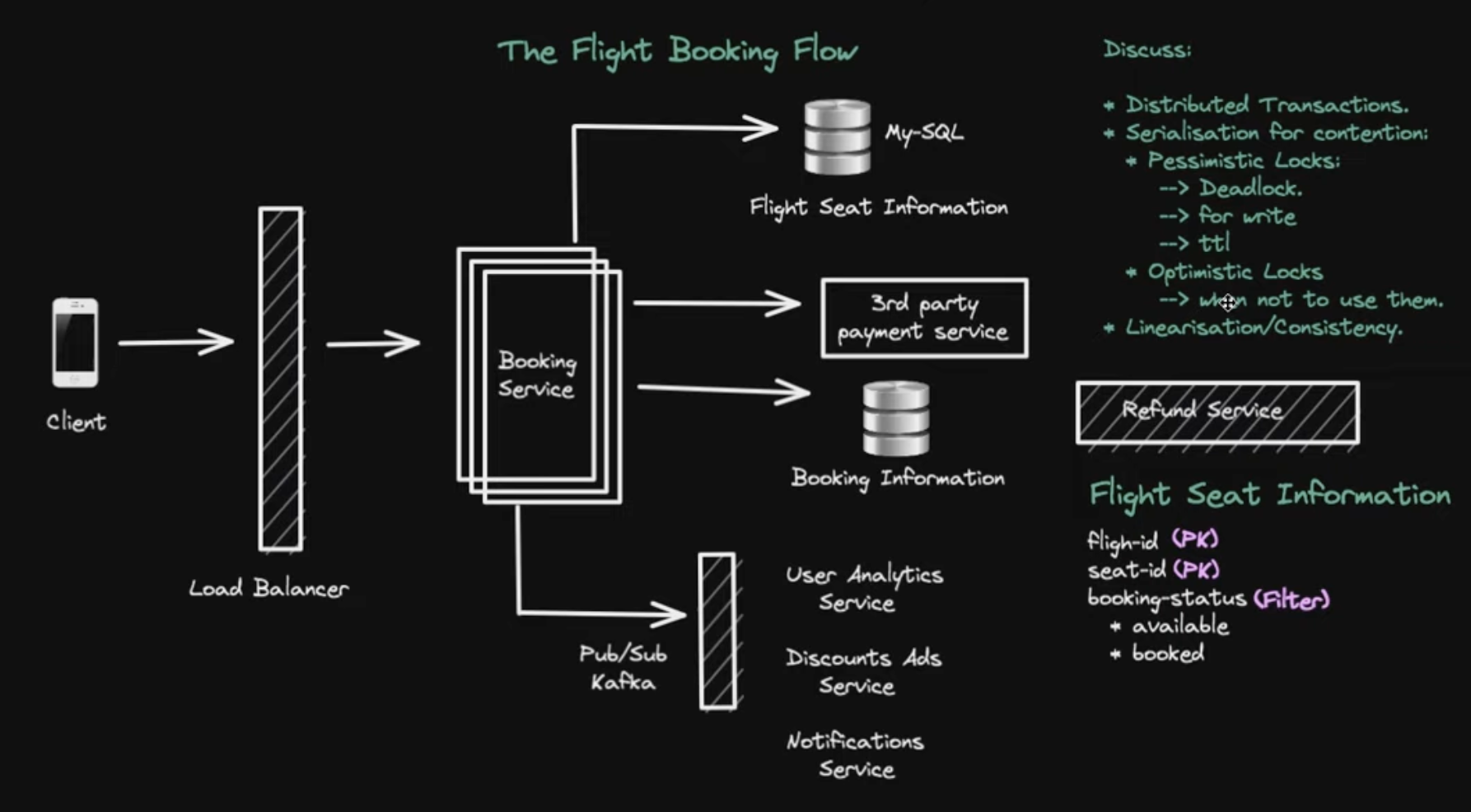
DB choices
possibles Challenges and tradeoff
Two phase commit Serialisation for contentions
Example Scenario: How to improve consistency keeping latency reduced
Imagine an airline booking system that maintains a single table for seat reservations. Without partitioning, every booking update might lock the entire table (or a large portion of it) to ensure consistency. Under heavy load, this leads to significant contention.
With Partitioning:
- You could partition the reservations table by flight number or date.
- Updates for different flights (or even different dates) occur in separate partitions.
- As a result, while updates for the same flight might still be serialized, updates for different flights can proceed in parallel.
- Each partition still maintains consistency through serialization, but because the data is divided, the likelihood of concurrent updates colliding is much lower. This approach enhances scalability and performance while still ensuring data integrity.”
Data Partitioning and Sharding:
- Effectively partitioning data (e.g., by flight number, geographic region, or time) to reduce contention and improve performance.